Recorded April, 1952, Los Angeles. Billie Holiday (vocal), Oscar Peterson (piano), Barney Kessel (guitar), Ray Brown (bass), J.C. Heard (drums)
Recorded April, 1952, Los Angeles. Billie Holiday (vocal), Oscar Peterson (piano), Barney Kessel (guitar), Ray Brown (bass), J.C. Heard (drums)
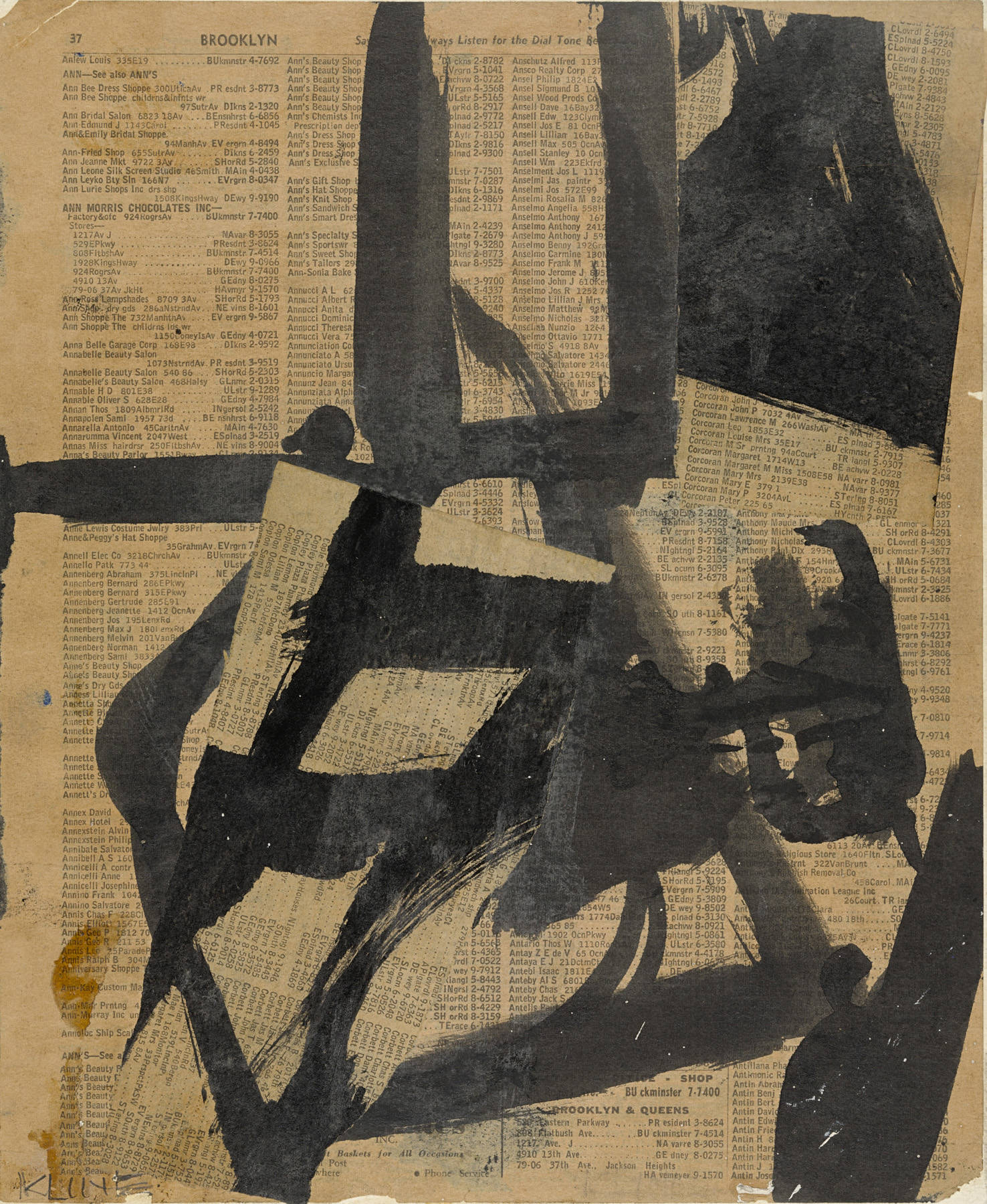
Franz Kline, “Untitled II” (c. 1952)
Franz Kline was born in Wilkes-Barre, Pennsylvania in 1910 and became an important participant in the Abstract Expressionist movement centered around New York City in the 1940s and 1950s.
After years of gradually moving away from his initially apolitical outlook, Sartre unambiguously sided with the Communist Party in 1952. He also became involved in a very public falling-out with former friend Albert Camus over their political differences, with both men attacking one another in the press. They never again met.
In this year, he also published Saint Genet, comédien et martyr, his extended study of the writer Jean Genet, whom he considered to be an outstanding example of existential authenticity.
Source:
Drake, David. Sartre. London: Haus, 2005. pp. 83-88, 162-163
西鶴一代女; film directed by Kenji Mizoguchi. There are a number of beautiful, subdued, and elegantly-paced scenes in this film about the misfortunes of a woman living during the Edo period. Mizoguchi uses his signature style, featuring many long takes, to effectively convey a socially-conscious message.
http://en.wikipedia.org/wiki/The_Life_of_Oharu
http://www.imdb.com/title/tt0045112/
In October 1952, at age 22, Jacques Derrida begins his studies at the École normale supérieure in Paris.
Peeters, Benoît. Derrida. Paris: Flammarion, 2010. pp. 71-84
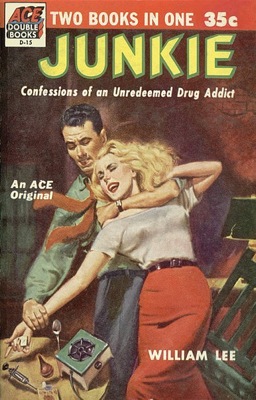
Cover of original 1953 edition, published by Ace Books.
Semi-autobiographical first novel by William S. Burroughs, written 1950-1952, renamed Junkie when first published in 1953 (under the pseudonym, “William Lee”), and later released as Junky. Starkly compelling literature, and considerably more lucid than the subsequent experimental texts for which Burroughs is better known.
http://en.wikipedia.org/wiki/Junkie_(novel)
Burroughs, William S., and Oliver Harris. Junky : the definitive text of ‘Junk’. London: Penguin, 2008. (Contains a number of texts left out of previous editions, and an informative introduction by Oliver Harris.)
See previous post.
This was a very important year in John Cage’s life. He continued to develop chance operations as a means to eliminate choice and personal taste from the process of musical composition. Also, he began to study Zen Buddhism at Columbia University with D. T. Suzuki. With Earle Brown, he produced the seminal sound-collage, Williams Mix, splicing over two thousand fragments of magnetic tape together by hand to produce a final piece just over four minutes in length. Along with Merce Cunningham, David Tudor, poet Charles Olson, and others, he orchestrated an unscripted theatrical/performance event that is considered to be the first “Happening.” Finally, in 1952 Cage composed what is probably his most famous work, the silent 4’33” for piano, whose debut performance (by David Tudor) took place on August 29 in Woodstock, New York. Increased attention from the press caused Cage’s fame, and notoriety, to grow.
Sources:
Silverman, Kenneth. Begin again : a biography of John Cage. New York: Alfred A. Knopf, 2010, pp.106-120.
Basualdo, Carlos, Erica F. Battle, and Calvin Tomkins. Dancing around the Bride : Cage, Cunningham, Johns, Rauschenberg, and Duchamp. Philadelphia, PA: Philadelphia Museum of Art, 2012, pp.311-312.
Recorded November, 1952, New York City. Stan Getz (tenor sax), Johnny Smith (guitar), Bob Carter (bass), Morey Feld (drums)
 Defective Mnemotechnic